
Healthcare Facility Security in St. Louis
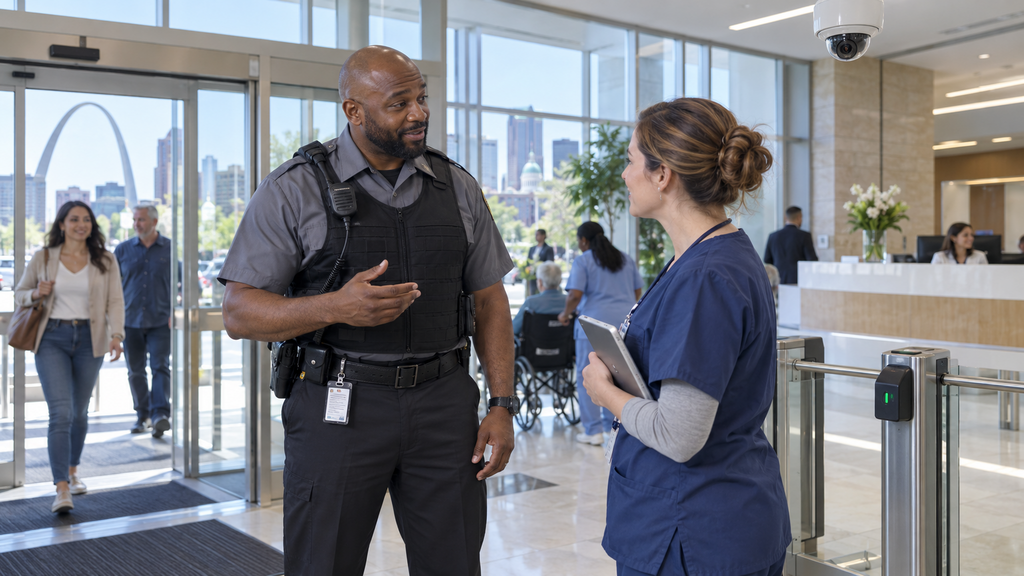
Hospitals, urgent care centers, and medical offices in St. Louis face security challenges that differ from typical commercial properties, from managing visitor access to responding calmly to agitated patients. Praetorian Guard Services provides officers trained specifically for healthcare environments, so your staff and patients stay safe without disrupting patient care.
We provide professional healthcare facility security in St. Louis designed to support safer environments without unnecessarily interfering with patient care. Our security officers can help monitor entrances, manage visitor access, maintain a visible presence, patrol facility grounds, document incidents, and respond calmly when security concerns arise.
Every healthcare facility operates differently. A hospital emergency department may need continuous coverage in waiting areas, while a specialty clinic may require visitor screening during business hours. A rehabilitation center may benefit from parking lot patrols, access monitoring, and after-hours security.
Praetorian Guard Services develops customized security plans around the facility’s layout, operating hours, patient population, existing safety policies, and identified risks. Our goal is to provide professional protection that supports healthcare personnel, patients, visitors, and daily operations.
CONTACT US TO FIND OUT MORE
Healthcare Security Services in St. Louis
Healthcare security requires more than placing an officer near an entrance. Officers must understand that medical facilities are sensitive environments where people may be frightened, confused, distressed, or experiencing a crisis.
A professional security presence can help discourage unauthorized access, disruptive behavior, theft, vandalism, workplace violence, and other incidents. Security officers also provide an immediate point of contact when employees, patients, or visitors need assistance with a security concern.
Our healthcare facility security services may include:
- Emergency department and waiting room security
- Visitor screening and access monitoring
- Uniformed armed and unarmed security officers
- De-escalation support for agitated individuals
- Parking lot, garage, and campus patrols
- Restricted-area monitoring
- Employee entrance and contractor access monitoring
- After-hours and overnight protection
- Alarm response and facility inspections
- Incident documentation and reporting
- Coordination with healthcare administrators and local law enforcement
- Off-duty police security for elevated security needs
Officer duties and coverage schedules are established according to the facility’s operational requirements, existing policies, and security objectives.
Emergency Department and Waiting Room Security
Emergency departments and waiting rooms can become crowded and emotionally charged. Patients and family members may face long waits, uncertain medical outcomes, or stressful circumstances that contribute to frustration.
A trained, visible security officer can monitor activity, identify developing concerns, assist staff when disruptive behavior occurs, and help maintain order while respecting the clinical environment. Officers can also observe entrances and exits, support visitor procedures, and communicate security concerns to designated facility personnel.
Security officers do not replace doctors, nurses, behavioral health professionals, or other clinical staff. Instead, they provide security support while following established facility procedures and the direction of authorized healthcare personnel.
Visitor Screening and Access Control
Healthcare facilities may contain patient rooms, treatment areas, pharmacies, laboratories, employee-only spaces, records departments, and other restricted locations. Controlling access helps protect patients, staff, medications, equipment, and sensitive areas.
Security officers can monitor public entrances, verify visitors according to facility procedures, issue or inspect visitor credentials, observe contractor access, and report unauthorized entry attempts. Officers may also help direct visitors to appropriate areas, reducing confusion while maintaining a professional and welcoming presence.
Access procedures can be customized for normal business hours, overnight periods, emergency departments, employee entrances, or special circumstances requiring additional oversight.
De-Escalation and Response to Disruptive Behavior
Healthcare workers regularly interact with individuals who may be frightened, confused, frustrated, intoxicated, emotionally distressed, or experiencing behavioral health symptoms. These circumstances require a calm and measured response.
Officers assigned to healthcare environments can receive training in de-escalation techniques, situational awareness, communication, and non-confrontational response. When appropriate, officers can help create distance, reduce tension, protect surrounding individuals, and notify clinical staff or law enforcement according to facility procedures.
Every incident is different. The officer’s response should reflect the immediate circumstances, the facility’s established policies, and the responsibilities of clinical personnel, security staff, and public safety agencies.
Parking Lot, Garage, and Campus Patrols
Healthcare security concerns are not limited to the inside of a building. Employees, patients, and visitors may arrive or leave early in the morning, late at night, or during periods when parking areas are less active.
Security officers can patrol parking lots, garages, walkways, loading areas, ambulance entrances, and other exterior spaces. Patrols provide a visible deterrent while helping identify suspicious activity, unauthorized vehicles, property damage, lighting concerns, or other conditions that require attention.
Larger hospitals and multi-building medical campuses may benefit from scheduled and randomized mobile security patrol services in St. Louis. Patrol schedules can be structured around shift changes, visiting hours, overnight periods, and other times when additional visibility may be valuable.
After-Hours and Overnight Healthcare Security
Many healthcare facilities operate outside standard business hours. Hospitals and emergency departments remain active around the clock, while clinics, medical offices, rehabilitation centers, and outpatient facilities may be largely unoccupied overnight.
After-hours officers can monitor access points, conduct interior or exterior patrols, respond to designated alarms, observe deliveries, and document suspicious conditions. Security coverage may also help protect medical equipment, vehicles, supplies, and other property during periods when fewer employees are present.
Coverage can be arranged for evenings, overnight shifts, weekends, holidays, or continuous 24/7 assignments depending on the facility’s requirements.
Incident Documentation and Communication
Detailed reporting is an important part of healthcare security. Administrators need accurate information about incidents, suspicious activity, access concerns, and recurring patterns that may affect facility operations.
Security officers can document relevant observations, actions taken, individuals involved, and notifications made. Reports can help administrators review incidents, evaluate existing security procedures, and identify areas that may need additional attention.
Clear communication between security officers, supervisors, facility administrators, risk management personnel, and clinical staff helps create a more coordinated security program.
Healthcare Facilities We Support
Praetorian Guard Services can develop security coverage for a range of healthcare and medical environments throughout St. Louis, St. Louis County, and nearby Missouri communities.
Hospitals and Emergency Departments
Hospitals may require continuous security across emergency departments, entrances, waiting areas, patient floors, parking facilities, and other high-traffic locations. Coverage can be structured around the size of the campus, visitor policies, peak activity, and identified risks.
Urgent Care and Walk-In Clinics
Urgent care centers frequently serve patients without scheduled appointments and may experience unpredictable visitor volumes. Security officers can monitor entrances, observe waiting areas, and respond to disruptive or suspicious behavior.
Outpatient and Specialty Medical Offices
Medical practices, dental offices, surgical centers, diagnostic facilities, and specialty clinics may benefit from reception-area security, access monitoring, parking patrols, and support during sensitive appointments or employee concerns.
Behavioral Health and Treatment Facilities
Behavioral health facilities require security personnel who can remain calm, communicate clearly, and follow facility-specific procedures. Coverage should be coordinated closely with clinical leaders so security supports the treatment environment and the responsibilities of healthcare professionals.
Long-Term Care and Rehabilitation Facilities
Rehabilitation centers, skilled nursing facilities, and long-term care communities may need visitor monitoring, property patrols, after-hours protection, and assistance with security-related incidents involving residents, guests, or unauthorized individuals.
Medical Campuses and Administrative Buildings
Large healthcare systems may include clinics, laboratories, offices, parking structures, storage buildings, and support facilities across multiple properties. A coordinated plan can combine fixed-post officers, mobile patrols, access control, and incident reporting.
Security Plans Built Around Your Healthcare Facility
No two healthcare facilities have the same layout, patient population, operating schedule, or security risks. For that reason, healthcare security should be based on a careful assessment rather than a standard coverage package.
Praetorian Guard Services can evaluate your entrances, waiting areas, parking facilities, restricted spaces, employee access points, operating hours, and existing security procedures. We then develop a practical plan that defines officer responsibilities, post locations, patrol routes, reporting expectations, escalation procedures, and coverage schedules.
A customized healthcare security plan may combine uniformed officers at fixed posts with mobile patrols, visitor management, after-hours inspections, surveillance support, and off-duty police officers when a higher level of authority or response capability is appropriate.
Security coverage can also be adjusted as circumstances change. Facilities may require additional officers during construction, staffing changes, high-volume periods, public events, labor concerns, or other situations that temporarily increase activity or risk.
Healthcare Surveillance and Security Technology
Cameras, alarms, access control systems, and communication tools can provide valuable information about activity across a healthcare property. However, technology is most effective when it is supported by clear procedures and trained personnel who can assess and respond to concerns.
Security officers can work alongside a facility’s existing cameras, alarms, electronic access systems, and visitor management procedures. Their physical presence allows them to observe situations directly, communicate with facility personnel, and respond according to established post instructions.
Praetorian Guard Services also offers mobile surveillance solutions for locations where permanent camera infrastructure may not be practical. Depending on the application, mobile monitoring may provide additional visibility for parking areas, temporary facilities, construction zones, equipment storage locations, or other parts of a healthcare campus.
Surveillance technology should be deployed in accordance with applicable laws and facility privacy policies. Camera placement and monitoring procedures should protect security interests without interfering with patient privacy or clinical care.
Supporting Patient Privacy and Facility Policies
Security officers may work near patients, visitors, employees, treatment areas, and information that requires discretion. Officers assigned to healthcare facilities should understand the importance of professional conduct and patient confidentiality expectations.
Before deployment, facility-specific rules should be reviewed with administrators. These may include restrictions on accessing patient areas, handling visitor information, discussing incidents, using communication devices, and documenting security events.
Security personnel should only receive information necessary to perform their assigned duties. They should not provide medical advice, access clinical records without authorization, or disclose patient information.
This approach helps security officers perform their protective role while respecting the facility’s privacy procedures and the responsibilities of authorized healthcare personnel.
Why Choose Praetorian Guard Services?
Choosing a healthcare security company in St. Louis requires careful consideration. Security officers may interact with vulnerable patients, worried family members, medical professionals, vendors, contractors, and members of the public. Their conduct can affect both safety and the experience people have at your facility.
Praetorian Guard Services focuses on professionalism, accountability, clear communication, and customized protection.
Customized Healthcare Security Plans
We develop each plan around the facility’s layout, operating schedule, patient and visitor activity, existing policies, and identified vulnerabilities. Officer duties are defined according to the actual needs of the assignment.
Professional Security Officers
Our officers are selected and prepared to work in environments where appearance, judgment, communication, and respectful conduct matter. Healthcare assignments can include additional site-specific orientation and training based on the facility’s requirements.
De-Escalation-Focused Response
Healthcare security often involves communication before physical intervention becomes necessary. Officers can use calm, non-confrontational techniques to help manage difficult situations while following facility policies and responding to immediate safety concerns.
Flexible Coverage Options
Healthcare security can be scheduled during peak hours, evenings, overnight periods, weekends, holidays, or on a continuous basis. Both armed and unarmed options are available depending on the facility’s risk profile and security objectives.
Detailed Incident Reporting
Accurate reports and consistent communication help administrators understand what occurred, how officers responded, and whether patterns require further review.
Local St. Louis Coverage
Praetorian Guard Services serves healthcare facilities throughout St. Louis, St. Louis County, and surrounding Missouri communities. Coverage can be developed for individual medical offices, large hospital campuses, and facilities with multiple locations.
When elevated security requirements call for additional authority and experience, we can also discuss off-duty police security in St. Louis as part of a customized security strategy.
Frequently Asked Questions
Are your officers trained to handle behavioral health incidents?
Officers assigned to healthcare environments can receive de-escalation and site-specific training relevant to behavioral health concerns. Their role is to support safety, communicate calmly, follow facility procedures, and involve clinical professionals or law enforcement when appropriate. Security officers do not replace trained behavioral health or medical personnel.
Can security officers be stationed specifically in the emergency department?
Yes. Security coverage can be assigned to emergency departments, waiting rooms, entrances, or other designated hospital areas. Schedules may be structured around continuous operations or peak-volume periods, depending on the facility’s needs.
Do your officers understand patient privacy requirements?
Officers are briefed on general patient confidentiality expectations as part of healthcare-site onboarding. Facility-specific privacy policies are always reviewed with administration before deployment.
Do you provide security for medical offices and urgent care centers?
Yes. Healthcare security services can be developed for hospitals, urgent care centers, medical practices, outpatient clinics, rehabilitation facilities, long-term care properties, and other medical environments.
Can healthcare security coverage be provided after hours?
Yes. Coverage can be arranged during evenings, overnight hours, weekends, holidays, or on a 24/7 basis. After-hours services may include entrance monitoring, patrols, alarm response, property inspections, and incident reporting.
How much does healthcare facility security cost in St. Louis?
The cost depends on the number of officers, coverage hours, armed or unarmed service, facility size, risk level, required duties, and any specialized coverage needs. A customized assessment provides a more accurate estimate based on the facility’s actual requirements.
Protect Your St. Louis Healthcare Facility
Healthcare professionals should be able to focus on patient care without carrying the full burden of managing security concerns. Whether your facility needs emergency department officers, visitor access monitoring, parking lot patrols, overnight protection, surveillance support, or a broader healthcare security strategy, Praetorian Guard Services can help.
We provide healthcare facility security in St. Louis with an emphasis on professionalism, calm communication, dependable coverage, and respect for the clinical environment.
Ready to discuss your facility’s security needs? Contact Praetorian Guard Services today for a free consultation and customized healthcare security proposal.